How Many Standard Drinks to Drive in NSW? Alcohol Limits Explained
- NS Criminal Lawyers & Associates
- Published 22 Oct 2026
- Traffic Law
- 11 min read
It is one of the most searched drink driving questions in Australia: how many standard drinks can you have and still drive under the limit? Most people want a simple number, such as two beers or a couple of glasses of wine. The honest answer is that there is no number that is safe for everyone, and guessing wrong in NSW means an immediate licence suspension, a fine and possibly a criminal record.
This guide explains the alcohol limit NSW drivers must follow in 2026, what a standard drink actually is, why counting drinks is unreliable, how long alcohol stays in your system, the penalties if you are over the limit, and what to do if you have been charged.
Quick answer: how many standard drinks can you have and drive in NSW?
There is no safe number of drinks. The legal limit in NSW is a blood alcohol concentration (BAC) under 0.05 for full licence holders, under 0.02 for drivers of heavy vehicles, buses, taxis and dangerous goods vehicles, and zero for learner, P1 and P2 drivers. Your BAC depends on your size, sex, food, health and the drinks you choose, and it can keep rising for up to 2 hours after your last drink. Transport for NSW recommends that you do not drink any alcohol if you plan to drive.
Charged with drink driving? Call 0414 444 474, available 24/7, or send us an enquiry.
What Is the Legal Alcohol Limit in NSW?
What is the alcohol limit in NSW? NSW has three limits, and the one that applies depends on your licence and the vehicle you are driving. The Transport for NSW alcohol and driving page sets them out:
| Your BAC limit | Who it applies to |
|---|---|
| Zero | Learner, P1 and P2 drivers and riders, and visitors with an overseas or interstate learner, provisional or equivalent licence |
| Under 0.02 | Drivers of vehicles over 13.9 tonnes gross vehicle mass, vehicles carrying dangerous goods, and public passenger vehicles such as taxis and buses |
| Under 0.05 | All other drivers, including full licence holders and most visitors |
So for full licence holders, the alcohol limit in NSW is under 0.05. A BAC of 0.05 means 0.05 grams of alcohol in every 100 millilitres of blood.
Drivers who must have a zero or 0.02 limit by law
The Road Transport Act 2013 goes further than the Transport for NSW summary. A zero limit (called a novice driver) also applies to interlock licence holders and to people who have never held a licence, or who have lost a learner, provisional or interlock licence. A 0.02 limit (called a special category driver) also applies to people driving while their full licence is suspended or cancelled. If you are driving without a valid licence, you are likely to be charged with two offences, not one.
The Legal Ranges: How BAC Is Measured
The ranges behind the legal alcohol limit in NSW are set out in section 108 of the Road Transport Act 2013. Police charge you according to the range your BAC falls in.
| Range | Blood alcohol concentration | Who commits the offence |
|---|---|---|
| Novice range | More than 0 but under 0.02 | Learner, provisional and interlock drivers, and people who have never held a licence |
| Special range | 0.02 to under 0.05 | Heavy vehicle, bus, taxi and dangerous goods drivers, novice drivers, and drivers whose licence is suspended or cancelled |
| Low range | 0.05 to under 0.08 | All drivers |
| Mid range | 0.08 to under 0.15 | All drivers |
| High range | 0.15 or more | All drivers |
When it comes to the blood alcohol limit in NSW, it is these ranges that decide the charge, the penalty and whether you have to go to court.
What Is a Standard Drink?
In Australia, a standard drink contains 10 grams of pure alcohol, according to the Department of Health standard drinks guide. Many common serves contain more than one standard drink:
| Drink | Approximate standard drinks |
|---|---|
| Can of full strength beer (375 ml, 4.8%) | 1.4 |
| Small glass of full strength beer (285 ml, 4.8%) | 1.1 |
| Large glass of full strength beer (425 ml, 4.8%) | 1.6 |
| Restaurant glass of red wine (150 ml) | 1.6 |
| Restaurant glass of white wine (150 ml) | 1.4 |
| Bottle of red wine (750 ml, 13.5%) | 8 |
| 30 ml serve of spirits (40%) | 1 |
| Can of full strength pre-mixed spirits (375 ml, 5%) | 1.5 |
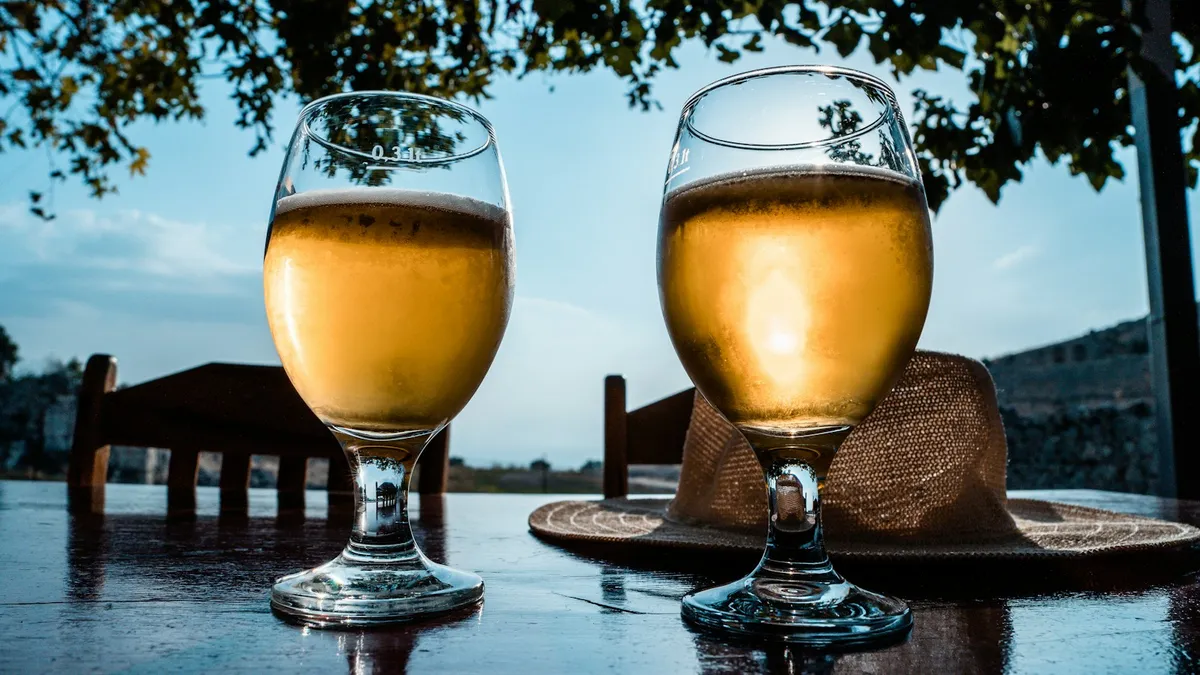
That is why "I only had two" is so often wrong. Two large beers can be more than three standard drinks, and two restaurant glasses of red wine are more than three.
How Many Drinks Is 0.05?
How many drinks is 0.05? There is no reliable answer. You may have heard a rule of thumb that men can have two standard drinks in the first hour and one an hour after that, and women one an hour. That rule is not a legal test, and it does not work for everyone.
Transport for NSW says that counting standard drinks to guess your BAC is difficult and often inaccurate, and the Alcohol and Drug Foundation says there is no amount of drinking that guarantees you will stay under 0.05. Two people who drink exactly the same amount can return very different readings because of:
- Body size. A smaller person will have a higher BAC from the same amount of alcohol.
- Sex. A woman of the same height and weight as a man, drinking the same amount, will usually have a higher BAC.
- Food. Drinking on an empty stomach means alcohol is absorbed faster. Eating does not lower your BAC faster.
- Health and liver function. An unhealthy liver processes alcohol more slowly.
- Tiredness, stress and illness. These can all push your BAC higher.
- Medications. Some medications slow the way your body processes alcohol.
- Drink sizes and strength. Drinks are often topped up or served in non-standard sizes.
So, how many standard drinks is 0.05 for you on a given night? Nobody can tell you in advance, including a calculator or an app. If you are a P plater, the answer is simple: none.
How many standard drinks to drive in NSW if you are on your Ps?
If you are on your L or P plates, the drink driving limit NSW law sets for you is zero. Even one standard drink can put you over. The same applies to interlock licence holders.
How Long Does Alcohol Stay in Your System?
Your BAC keeps rising after you stop drinking
Transport for NSW warns that your BAC starts to rise as soon as you start drinking and may continue to increase for up to two hours after you stop. Leaving the pub straight after your last drink does not mean you are at your highest reading.
The body processes about 1 standard drink an hour
According to the Alcohol and Drug Foundation, it generally takes the body about 1 hour to process 1 standard drink. Nothing speeds this up. Coffee, water, a cold shower, food or sleep do not lower your BAC faster.
How long does alcohol stay in your breath?
People often ask how long alcohol stays in your breath the morning after a big night. Because the body processes alcohol at roughly a standard drink an hour, a person who finished 10 standard drinks at 1 am may still have alcohol in their system well into the next morning. Transport for NSW says that after a big night out you may still have alcohol in your system for much of the next day. Many drink driving charges are laid on people driving to work or dropping children at school the morning after.
Drink Driving Penalties in NSW
If you are over your limit, the penalty depends on your range and whether it is a first or second offence within 5 years. The amounts below come from the NSW Government drink driving penalties page, and the penalty notice amount was confirmed against the Judicial Commission of NSW Lawcodes database.
| Offence (first offence) | Penalty notice or court | Maximum fine | Maximum prison | Licence consequence |
|---|---|---|---|---|
| Novice, special or low range | Penalty notice of $722 (from 1 July 2026) and immediate 3 month suspension, or court | $2,200 | None | Automatic 6 month disqualification if dealt with by a court (minimum 3 months) |
| Mid range | Court | $2,200 | 9 months | Immediate suspension, automatic 12 month disqualification (minimum 6 months), alcohol interlock order |
| High range | Court | $3,300 | 18 months | Immediate suspension, automatic 3 year disqualification (minimum 12 months), alcohol interlock order |
For a second or subsequent offence within 5 years, every penalty increases. Even a low range repeat offence goes to court, with a fine of up to $3,300, an automatic 12 month disqualification and an alcohol interlock order. Refusing a breath analysis at the police station or testing vehicle is also a serious offence. A first offence carries up to 18 months imprisonment, a fine of up to $3,300 and an automatic 3 year disqualification, according to the Lawcodes database.
Drink driving offences do not attract demerit points. Instead, you lose your licence through suspension or disqualification. For more about what happens after a charge, see our guide to what happens after drink driving in NSW.
The alcohol interlock program
For mid range, high range, repeat and refusal offences, the court must make an alcohol interlock order unless an exemption applies. After a minimum disqualification, you can only drive a car fitted with an interlock device that you blow into before starting the engine. When an interlock order is made, the disqualification periods are different from those in the table above. See our guide to the alcohol interlock program.
How Strictly Is Drink Driving Enforced in NSW?
NSW Police conduct random breath testing every day, and testing increases sharply over holiday periods. During the Christmas and New Year traffic operation from 19 December 2025 to 4 January 2026, NSW Police conducted 597,703 breath tests and detected 939 drink driving offences. Transport for NSW says drink driving is a factor in about 1 in every 7 crashes in NSW where someone dies.
Common Drink Driving Myths
- "I'll be fine after a coffee." Coffee may make you feel more alert, but it does not lower your BAC.
- "I ate a big meal, so I can have more." Food slows absorption, but it does not stop alcohol entering your blood or make you process it faster.
- "Light beer doesn't count." Light beer has less alcohol, but several light beers still add up, and P platers must have zero.
- "I slept, so I'm sober." Sleep does not speed up your liver. You can still be over the limit in the morning.
- "I only moved the car." Driving even a short distance, or sitting in the driver's seat and trying to start the car, can be an offence.
- "A personal breathalyser will protect me." Personal devices can give a useful indication, but they are not a defence if a police test shows you were over your limit.
Charged With Drink Driving? What You Can Do
A drink driving charge is serious, but the outcome is not decided at the roadside. Depending on your situation:
- Get advice before you pay a penalty notice or go to court. For a low range first offence, you can usually pay the penalty notice, or elect to go to court. Each choice has different consequences for your licence and your record.
- Check the evidence. Police must follow strict procedures for breath tests and breath analysis, including time limits. A lawyer can check whether the test was valid.
- Prepare for court. Courts can sometimes deal with a first, lower range offence under section 10 without recording a conviction or disqualifying your licence, especially if you have a good record and a real need to drive. A section 10 is not available if you received one for a drink or drug driving offence, or certain other serious driving offences, in the previous 5 years.
- Complete the Traffic Offender Intervention Program. Completing the Traffic Offender Intervention Program before your court date shows the court you have taken the offence seriously.
- Gather references. Good character references can make a real difference at sentencing.
Never drive while your licence is suspended or disqualified. That is a separate offence with its own penalties. See our driving while suspended or disqualified page.
Facing a drink driving charge? Call 0414 444 474, available 24/7, or see our drink driving lawyers page.
Frequently Asked Questions
What is the legal alcohol limit in NSW?
Under 0.05 for full licence holders, under 0.02 for heavy vehicle, bus, taxi and dangerous goods drivers, and zero for learner and P plate drivers.
How many standard drinks can I have and drive in NSW?
There is no safe number. Your BAC depends on your body, food, health and the drinks you choose. Transport for NSW recommends that you do not drink any alcohol if you plan to drive.
How many standard drinks is 0.05?
It varies from person to person. For some people, only a small number of drinks is enough to reach 0.05. Counting drinks is not a reliable way to stay under the limit.
Can P platers have any alcohol before driving in NSW?
No. Learner, P1 and P2 drivers must have a zero BAC. Even a small amount of alcohol is an offence.
How long after drinking can I drive?
It generally takes about 1 hour for the body to process 1 standard drink, and your BAC can keep rising for up to 2 hours after you stop. After a big night, you may still be over the limit the next morning.
What is the penalty for low range drink driving in NSW?
For a first offence, a $722 penalty notice and an immediate 3 month licence suspension, or a court fine of up to $2,200 and an automatic 6 month disqualification if the matter goes to court.
Do drink driving offences carry demerit points?
No. Drink driving leads to a licence suspension or disqualification instead of demerit points.
Talk to a Drink Driving Lawyer
If you have been caught over the limit, the steps you take before your court date matter. We advise drivers across Sydney on penalty notices, court elections, section 10 applications and the interlock program, and we offer fixed fees for traffic matters where possible.
Call 0414 444 474, available 24/7, or contact us online for confidential advice.
This article provides general information about NSW law as at October 2026. It is not legal advice. Penalty notice amounts change every 1 July. The standard drink figures are approximate and are not a safe drinking guide. For advice about your situation, speak with a lawyer.
Part of our NSW Criminal Law Knowledge Centre: Traffic Offences
About NS Criminal Lawyers & Associates
Experienced criminal and traffic defence representation across Sydney and New South Wales. Protecting your rights with integrity and commitment, available 24/7.
- Barangaroo (Sydney CBD)Level 35, Tower One, 100 Barangaroo Ave, Barangaroo NSW 2000
- ParramattaLevel 14, 3 Parramatta Square, 153 Macquarie Street, Parramatta NSW 2150
Related Articles
- Double Demerits NSW 2026: Christmas Dates, Offences and Points22 Oct 2026
- Red Light Camera Fine NSW 2026: Fines, Demerit Points and Your Options15 Oct 2026
- Speeding Fines NSW 2026: Fines, Demerit Points and Licence Suspensions7 Oct 2026
- Medicinal Cannabis and Driving in NSW: The New Defence Explained30 June 2026
- Demerit Points in NSW: How They Work and How to Save Your Licence20 June 2026
- Drug Driving vs Drink Driving in NSW: What's the Difference?5 June 2026