Knife Laws NSW 2026: Can You Carry a Knife in Public?
- NS Criminal Lawyers & Associates
- Published 14 Oct 2026
- Criminal Law
- 14 min read
A pocket knife in your bag, a fishing knife left in the car or a kitchen knife you are taking to a friend's barbecue. Most people never think twice about it, but under knife laws in NSW carrying a knife in a public place without a good reason is a criminal offence with a maximum penalty of 4 years in prison. Police also have new powers to scan people for knives in busy public areas without suspecting them of anything.
This guide explains the current NSW knife laws in plain English: what counts as a knife, when you are allowed to carry one, which knives are banned completely, the penalties, police search and wanding powers, and what to do if you have been charged.
Quick answer: is it legal to carry a knife in NSW?
Only if you have a reasonable excuse. Under section 93IB of the Crimes Act 1900 (NSW) it is an offence to have a knife in your custody in a public place or a school without a reasonable excuse, such as needing it for work, cooking, fishing or sport. Self-defence is not a reasonable excuse. The maximum penalty is 4 years in prison and/or a fine of $4,400, although most first offences are dealt with in the Local Court or by a $550 penalty notice.
Charged with a knife offence? Call 0414 444 474, available 24/7, or send us an enquiry.
What Counts as a Knife Under NSW Law?
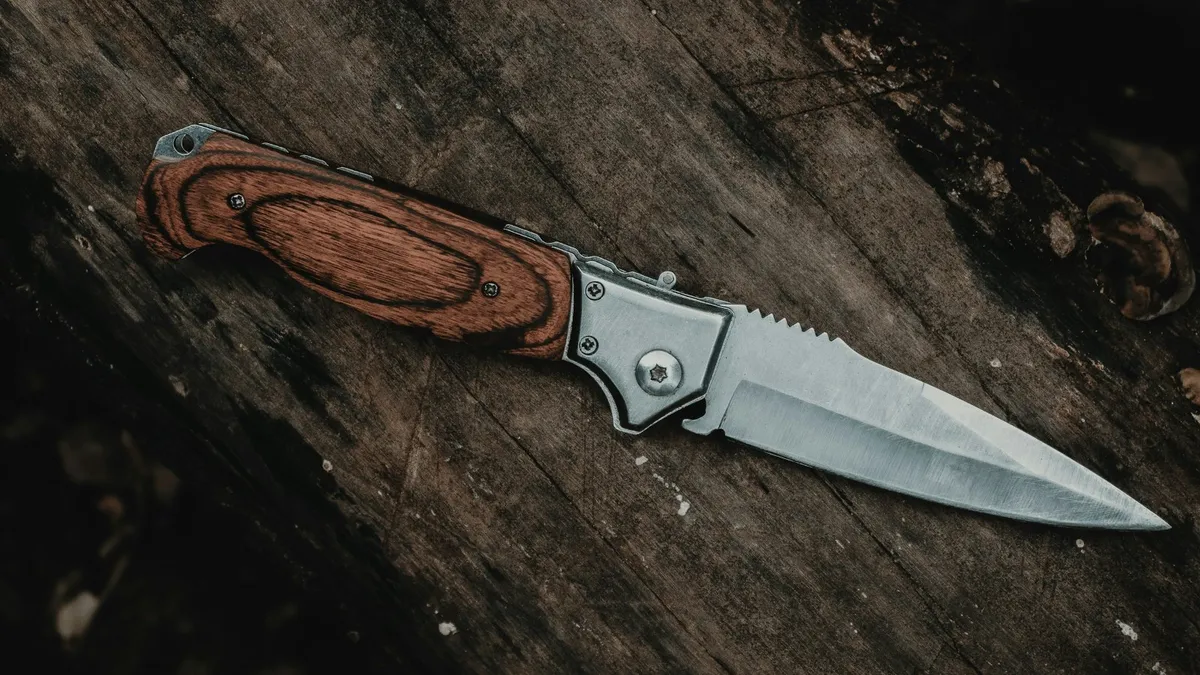
The knife offences are in Division 2A of Part 3A of the Crimes Act 1900 (NSW). Section 93IA defines a knife very broadly. A "knife" includes a blade, and a "blade" includes a knife blade and a razor blade. There is no minimum blade length, so the law covers:
- Kitchen and steak knives
- Folding pocket knives and multi tools with a blade
- Box cutters, Stanley knives and utility blades
- Razor blades
- Fishing, hunting and camping knives
The regulations can exclude certain classes of knife from the definition, but at the time of writing no classes have been excluded. That means a small pocket knife is treated the same way as a large kitchen knife for the custody offence. The size and type of knife does matter later, when a court decides the penalty.
Where the Law Applies: Public Places and Schools
The offences apply in a public place or a school. Both terms take their meaning from section 3 of the Summary Offences Act 1988 (NSW).
A public place is any place, or part of premises, that is open to or used by the public, whether or not you have to pay to get in. Streets, parks, beaches, train stations, shopping centres, pubs, clubs, sporting grounds and car parks are all public places. A school includes government and registered non-government schools, preschools and child care centres, along with their grounds and buildings.
Your own home is not a public place, so keeping knives at home is lawful. The law is about knives you take out with you. A knife in your car can also lead to a charge, because a car on a road or in a car park is usually in a public place. Whether you had the knife in your custody, and whether you had a reasonable excuse, depends on the facts of each case.
The Offence of Custody of a Knife in a Public Place (Section 93IB)
Section 93IB(1) of the Crimes Act says a person must not have a knife in their custody in a public place or a school. To prove the charge, the prosecution must show beyond reasonable doubt that:
- You had the knife in your custody (for example, on your body, in your bag or within your control in a vehicle)
- The item was a knife within the meaning of section 93IA
- You were in a public place or a school at the time
Notice what is missing. Police do not have to prove you intended to use the knife, or that you threatened anyone with it. Simply having it with you is enough, unless you can show a reasonable excuse.
What Is a Reasonable Excuse to Carry a Knife?
Under section 93IB(2), it is a defence if you prove you had a reasonable excuse. Section 93IB(3) lists situations that count as a reasonable excuse, where having the knife is reasonably necessary for:
- The lawful pursuit of your occupation, education or training (for example, a chef, tradesperson or butcher)
- Preparing or eating food or drink (for example, taking a knife to a picnic or barbecue)
- Taking part in lawful entertainment, recreation or sport (for example, fishing, camping or hunting)
- Displaying knives for retail or other trade purposes
- An organised exhibition by knife collectors
- Wearing an official uniform
- Genuine religious purposes (for example, a Sikh kirpan)
Travelling to or from one of these activities is also covered. If you are driving home from a fishing trip with your knife in the tackle box, that can be a reasonable excuse. The list is not exhaustive, so other genuine reasons can also be argued in court.
Unlike most parts of a criminal case, the burden here is on you. You must prove the reasonable excuse on the balance of probabilities, which means showing it is more likely than not. Receipts, a work roster, a fishing licence, the place you were going and the way the knife was packed can all help.

Self-Defence Is Not a Reasonable Excuse
Section 93IB(4) makes it clear that carrying a knife for self-defence, or to defend another person, is never a reasonable excuse. This surprises many people, especially those who carry a knife because they feel unsafe at night or at work. If you tell police the knife is "for protection", you are effectively admitting the offence. For a full explanation of when force in self-defence is lawful, read our guide to self defence laws in NSW.
The Offence of Using or Carrying a Knife in a Threatening Way (Section 93IC)
Section 93IC is a more serious offence. It applies if you use a knife, or carry a knife that is visible, in the presence of another person in a public place or school, in a way that is likely to make a reasonable person fear for their safety. Waving a knife during an argument, or walking through a shopping centre with a large blade on show, are typical examples. A reasonable excuse defence is also available for this offence.
If the knife is actually used to threaten or injure someone, police may lay other charges as well, such as assault, assault occasioning actual bodily harm, affray or intimidation. These can carry much higher penalties.
Knife Possession Penalties in NSW
The knife offences were moved from the Summary Offences Act into the Crimes Act by the Criminal Legislation Amendment (Knife Crimes) Act 2023, which commenced on 23 October 2023. The maximum prison term doubled from 2 years to 4 years, and the offences became indictable. The current penalties, confirmed against the Judicial Commission of NSW Lawcodes database, are set out below. One penalty unit is $110.
| Offence | Law | Maximum penalty (District Court) | Maximum penalty (Local Court) | Penalty notice |
|---|---|---|---|---|
| Custody of a knife in a public place or school, first offence | Crimes Act 1900, s 93IB | 4 years prison and/or 40 penalty units ($4,400) | 2 years prison and/or $4,400 | $550 (at police discretion) |
| Custody of a knife in a public place or school, subsequent offence | Crimes Act 1900, s 93IB | 4 years prison and/or $4,400 | 2 years prison and/or $4,400 | Not available |
| Using or carrying a knife in a way that causes fear | Crimes Act 1900, s 93IC | 4 years prison and/or 100 penalty units ($11,000) | 2 years prison and/or $11,000 | Not available |
| Possessing or using a prohibited weapon (including banned knives) | Weapons Prohibition Act 1998, s 7 | 14 years prison | 2 years prison if finalised in the Local Court | Not available |
Both Crimes Act knife offences are "Table 1" offences under the Criminal Procedure Act 1986 (NSW). That means they stay in the Local Court unless the prosecution or the accused person elects to have them dealt with in the District Court. In practice, most charges are finalised in the Local Court, where the maximum prison term is 2 years.
Penalty Notices for a First Offence
For a first offence of custody of a knife, police can issue a $550 penalty notice instead of a court attendance notice. Whether you get one is up to police. Paying a penalty notice does not result in a conviction, but it is recorded and it can count as a previous knife offence if you are caught again. If you believe you had a reasonable excuse, you can elect to have the matter heard in court instead of paying. Speak to a lawyer before you decide, because the time to elect is limited.
What Penalty Will the Court Give?
A court can deal with a knife possession charge in many ways, from a dismissal without conviction to a prison sentence. Factors that affect the outcome include:
- The type and size of the knife, and whether it was concealed
- Where you were, and whether it was a school, a crowded venue or a late night precinct
- Your explanation for having the knife, even if it falls short of a legal defence
- Your age, criminal history and any previous weapons offences
- Whether the knife was linked to any threat or other offence
For a first offence with a genuine but legally insufficient reason, such as forgetting a work knife in a jacket pocket, a section 10 non-conviction order may be possible. Every case depends on its own facts. See our guide to sentencing and penalties in NSW for the full range of options.
Pocket Knife Laws NSW: Common Questions Answered
Pocket knives cause more confusion than any other type of knife. Here is how the law applies in everyday situations:
- Can I carry a pocket knife "just in case"? No. A general wish to have a knife handy is not a reasonable excuse.
- Can I carry a multi tool with a blade? Only with a reasonable excuse, such as using it for your job that day.
- Is a small blade treated differently? Not for the offence itself. There is no minimum blade length in NSW.
- Can I keep a knife in my car? Only if you have a reasonable excuse, such as camping or fishing gear, or tools for work.
- What about knives for religious reasons? Carrying a knife for genuine religious purposes, such as a kirpan, is listed as a reasonable excuse.
Banned Knives: Prohibited Weapons in NSW
Some knives are illegal to own at all without a permit, even at home. Under Schedule 1 of the Weapons Prohibition Act 1998 (NSW), the following are prohibited weapons:
- Flick knives (switchblades) that open automatically by gravity, centrifugal force or a button or spring
- Butterfly knives (balisongs) that open by gravity or centrifugal force
- Ballistic knives that fire a blade
- Sheath knives whose sheath withdraws into the handle
- Push daggers and trench knives (knives with a knuckle duster style handle)
- Star knives (throwing stars)
- Zombie knives, meaning serrated multi-edged knives marketed or marked in a way that suggests violence
- Knives disguised as other objects, such as belt buckle knives
Possessing or using a prohibited weapon in NSW without a permit carries a maximum penalty of 14 years in prison under section 7 of the Act. The same Schedule also bans many items people buy for self-protection, including capsicum (pepper) spray, tasers and stun devices, knuckle dusters and extendable batons. If you are facing a possess prohibited weapon charge, get legal advice early, because these are serious charges.

Police Search Powers and Knife Wanding in NSW
Outside special areas, police generally need a reasonable suspicion before they can search you, for example a suspicion that you are carrying a dangerous implement. Since 9 December 2024, Part 4A of the Law Enforcement (Powers and Responsibilities) Act 2002 (NSW) has given police an extra power known as wanding.
Here is how knife wanding works under the current law:
- A senior police officer (currently an Assistant Commissioner or above) can declare a designated area, such as a public transport station, shopping precinct, sporting venue or another prescribed public place (for example, a special event or night time economy area).
- A declaration can only be made if relevant knife, weapon or violent offences have happened at that place within the previous 12 months.
- A declaration lasts up to 12 hours.
- Inside a designated area, police can require you to stop and be scanned with a handheld metal detector, without needing to suspect you of anything.
- If the scanner goes off, police can ask you to produce the item. Finding a knife can lead to a search and a charge.
- Refusing to be scanned without a reasonable excuse is an offence, with a maximum fine of $5,500.
The government has introduced the Law Enforcement (Powers and Responsibilities) Amendment (Knife Scanning) Bill 2026 to make these powers permanent, extend declarations to 24 hours and let a Superintendent declare an area. At the time of writing (October 2026) the current law still limits a declaration to 12 hours. Police use the powers often. In September 2026, a 36 hour statewide operation reportedly saw police scan more than 4,400 people and seize 108 weapons, 85 of them knives, with more than 150 people charged. Read more in our article on knife wanding powers in NSW, and know your rights when arrested.
Knife Laws for Young People and Parents
Children and teenagers can be charged with knife offences, although young people may be dealt with under the Young Offenders Act 1997 (NSW) through cautions or youth justice conferences in suitable cases. There are also rules for adults:
- Parents: Under section 11D of the Summary Offences Act, a parent who knowingly authorises or permits their child to commit the section 93IB offence can be fined up to 5 penalty units ($550).
- Retailers: Under section 11F, selling a knife to a child under 16 is an offence, and selling a knife to a 16 or 17 year old is an offence unless there is a reasonable excuse (such as the child needing it for work or training). The maximum penalty is 100 penalty units ($11,000) and/or 12 months in prison, and employers can be held responsible for their staff.
Knife Laws Australia: How NSW Compares
Every Australian state and territory has its own knife laws, and they are not the same. Queensland introduced wanding powers before NSW under "Jack's Law", and other states have recently tightened their rules on items such as machetes. What is legal to carry or buy in one state may be an offence in another. If you are travelling interstate with knives for work or recreation, check the local law before you go. This article covers NSW law only.
What to Do If You Are Charged With a Knife Offence
If police find a knife on you, the steps you take early can make a real difference:
- Stay calm and be polite. Do not resist a scan or search, even if you believe it is unlawful. You can challenge it later.
- Think before explaining. You have the right to remain silent. Telling police the knife is for protection can hurt your case. Read our guide to police questioning rights in NSW.
- Keep evidence of your reason. Work rosters, receipts, fishing or camping gear, and messages about your plans can support a reasonable excuse.
- Do not pay a penalty notice or plead guilty straight away. Get advice first about whether you have a defence.
- Speak to a criminal lawyer. A lawyer can assess the evidence, argue a reasonable excuse, challenge an unlawful search and, if needed, put the best case to the court for a lenient outcome.
Frequently Asked Questions
Is it illegal to carry a knife in NSW?
It is illegal to have a knife in a public place or a school unless you have a reasonable excuse, such as needing it for work, food, sport or religious purposes. Self-defence is not a reasonable excuse.
What are the knife laws in NSW for pocket knives?
Pocket knives are treated like any other knife. There is no minimum blade length, so carrying a pocket knife in public without a reasonable excuse is an offence.
What is the penalty for carrying a knife in NSW?
The maximum penalty for custody of a knife in a public place is 4 years in prison and/or a $4,400 fine. In the Local Court the maximum prison term is 2 years. A first offence can be dealt with by a $550 penalty notice.
Can I carry a knife for self-defence in NSW?
No. Section 93IB(4) of the Crimes Act says self-defence and the defence of another person are not reasonable excuses for carrying a knife.
Can police search me for knives without a reason?
Usually police need a reasonable suspicion to search you. In a declared designated area, such as some train stations and shopping precincts, police can scan you with a metal detector wand without suspecting you of anything.
Are butterfly knives and flick knives legal in NSW?
No. They are prohibited weapons under the Weapons Prohibition Act 1998. Possessing one without a permit carries a maximum penalty of 14 years in prison.
Will I get a criminal record for carrying a knife?
Not necessarily. Paying a penalty notice does not create a conviction, and courts can dismiss a charge without conviction under section 10 in suitable cases. The outcome depends on your circumstances and history.
Speak to Our Criminal Lawyers About a Knife Charge
NS Criminal Lawyers & Associates defends people charged with knife and weapons offences across Sydney and NSW. We can advise you on a reasonable excuse defence, challenge the evidence and represent you in court.
Call 0414 444 474, available 24/7, or contact us online. In-person consultations at our Barangaroo and Parramatta offices are a paid service, and we provide fixed fee quotes where possible. Learn more about our weapons offence lawyers and our criminal defence lawyers in Sydney.
This article provides general information only and is not legal advice. The law referred to is current in New South Wales as at the date of publication. For advice about your circumstances, please contact a qualified criminal defence lawyer.
Part of our NSW Criminal Law Knowledge Centre: Charges
About NS Criminal Lawyers & Associates
Experienced criminal and traffic defence representation across Sydney and New South Wales. Protecting your rights with integrity and commitment, available 24/7.
- Barangaroo (Sydney CBD)Level 35, Tower One, 100 Barangaroo Ave, Barangaroo NSW 2000
- ParramattaLevel 14, 3 Parramatta Square, 153 Macquarie Street, Parramatta NSW 2150
Related Articles
- Self Defence Laws NSW: When Is Using Force Legal?14 Oct 2026
- What Is Affray in NSW? Meaning, Penalties and Defences7 Oct 2026
- New Organised Crime Bill Would Expand Digital Evidence Access Orders1 Sept 2026
- Charged With Drug Possession in NSW? The Law Explained28 Aug 2026
- Sexual Touching Charges in NSW: The Law Explained25 Aug 2026
- Bail Pending Appeal in NSW: Do You Go to Custody While Your Appeal Is Heard?24 Aug 2026